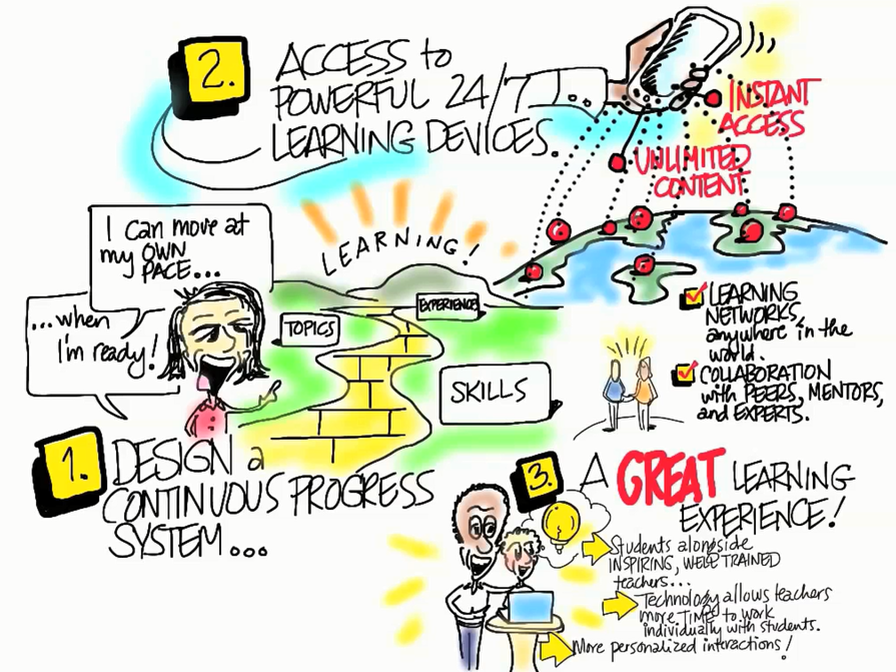
Student centered learning engages every student regardless of skill level and prepares every student for college readiness, career readiness, and civic engagement.
Principles of student centered learning include:
Learning is personalized
Together students and teachers create customized learning experiences based on development needs, skills, and interests
Learning is competency based
Students progress as they become proficient
Students given clear criteria for success and examples of exemplar work
Learning takes place anywhere/anytime
Credit for learning outside "typical" educational settings
Student exert ownership over their learning
Data is meaningful to them
Students reflect and provide feedback
Students practice self-efficacy and work on growth mindset
If we are truly going to engage in student centered learning then we must evaluate what data is collected and how it is used in education. The reality of our current system is that data is used to rank and sort students. How much of the data that is generated and used is actually meaningful to the individual student? Does it actually guide/inform their learning? We spend more time trying to make meaning of the data we have than actually supporting students in finding meaningful data to them.
One of my favorite books is Drive by Daniel Pink. For me, this was a game changer in our approach to personalized learning at FHS. Pink spelled out what really motivates people - autonomy, purpose, and mastery. If you think about our current education system we do not provide our students, or staff, opportunities to leverage any of three drivers in their own learning. Instead our current system is based on control and compliance which has lead to disengaged students and staff.
So, the question is "how do you incorporate autonomy, purpose, and mastery into the classroom?" In my mind, teachers have to experience it first hand before they see how these can increase student motivation. They have to feel these in action. The only way to do that is to give up some control - something administrators are not always good at.
Over the past three years at Farmington High School we have experimented with various forms of personalized professional development. We started by flipping some PD sessions and then moved to an EdCamp style format. The flipping was a good way to introduce staff to autonomy. They had some control over when and where they watched the video. The EdCamp model introduced purpose and mastery to autonomy. Sessions were created based on what staff wanted to learn more. Each session was tailored to the specific needs and interests of those taking part discussion.
This progression laid the groundwork for our approach to professional development at FHS. Today is a professional development day at FHS, but you would never know it by being in the building. You do not see the traditional large group instruction that is associated with professional development. Instead we set up a framework and turned over the 8 hours of professional development that would have been "given" to them today and teachers were allowed to set their goals for those hours, determine how they would meet the goals and decide how they would share their their learning. This is exactly what we want our students to be able to do!!!
The results and feedback have been amazing. Staff love the freedom to determine what they want to learn or improve. My role has changed from a deliverer of content to a support. I have more conversations with staff about their learning and how I can support them than ever before - the best part is it is something they are excited about. My goal in this process is to model this process so they can apply it in their classrooms. Teachers get to feel how autonomy, purpose, and mastery make their learning more valuable and to be honest more enjoyable.
How can we expect our approach to classroom instruction to change if we do not approach teacher learning differently?
I remembered seeing this video for the first time while watching Sunday Night Football last year. I laughed out loud and then thought to myself "look how much fun those kids are having." I then jumped into principal mode and thought "our classrooms need to look like this."
What do I mean by that? Well, sometimes we need to lose a little control and not look at everything in our classroom as this or that. These kids were dancing and playing football. Obviously, they at the high school game to play a small exhibition. The goal was to display their football skills. Did they do that? Yes. Could have the coaches tried to regain some control to make the scrimmage look better? Yes. But I would ask at what cost? What would have happened if the coaches tried to get the players to stop dancing? Simple. They would have spent all their time trying to regain control and to be honest it would have taken away the "fun" they were having. They would not have been able to run another play.
These coaches were smart. They let the kids go. They understood they could play football and dance!! These kids where having the time of their lives, even the ones who were cold and wanted to go home.
So remember you may have to give up a little control to engage all your students. That's ok, but a little whip and nae-nae never hurt anyone!!
I'd like you to meet Audri. He may be only 7, but he gets what learning is all about . . . mistakes (he calls them failures). He understands mistakes will happen and accepts them as part of his design process.
How do we get students to not fear failure? How do we understand that mistakes are vital to learning? Part of the solution needs is leveraging each student's natural desire for autonomy, purpose, and mastery. We need to set up environments were the learning is authentic and based on student interest. Just think of all the math and physics Audri had to apply to get his monster trap to work - these concepts will stick with him much longer and he will be able to apply them to other settings easier than if they were introduced and practiced separately (which is what we do now is school). Creativity and problem solving cannot be taught in isolation.
The real value of the video is that students will persevere through mistakes/failures when they anticipate they will happen and there is not penalty for making them. Unfortunately our system penalizes mistakes and does not celebrate them.
The funniest part of the video is when the monster trap works. It wasn't that it worked, but it only took 3 failures!! We need all our students to be that excited when they learn!!
The one nice thing about break is that it gives us time to think and reflect. My goal is to do a better job of writing my thoughts down in this Blog. I had a chance to run every day over break . . . I have a lot of thoughts 😃!!
What do you think when you see this?
Most people either see this as half-full (optimistic/positive) or half-empty (pessimistic/negative). The metaphor of the glass being half-full or half-empty is used all of the time, but what if we approached the glass differently? What if we didn't worry about how much water was in the glass or even if there was any water in the glass? How would this transform your thinking?
Over the last five years our district has been on a journey to transform the learning experience of our students. The one thing I have learned is that the current way of thinking about learning (no matter how you see the glass - half-empty or half-full) gets in the way of true transformation. We need to look at situations/opportunities differently and develop alternative methods of assessing. In other words we need to look at the glass differently.
What if we look at the glass like this?
What if we looked at the glass as refillable? How would this change your approach? I love this since no matter how much water is in the glass if we do something different we may spill some or all of the water. This fear of having only a finite amount paralyzes us and prevents us from doing something different - something that may be better than what we are currently doing.
To transform we must think and do differently. We must not let the fear of failure (or mistakes) prevent us from engaging all students in learning activities that are meaningful to them. Trying to do this within the current system is difficult, but it can be done!! We will spill some water, but that's ok . . . we have more!! I challenge you to look at all situations through a different frame of reference. An easy place to start is with a glass of water.
Here is the picture that got me thinking about this on a run earlier this week - saw it on Facebook
I had the opportunity to observe one of our band classes last week and was blown away by what I saw. We all can close our eyes and see a band rehearsal. The director stands up front, directs students when to start and when to stop - giving feedback to each section as they practice different parts of the piece and then starting that process all over again.. The director directs and the students focus on their instrument and section. The student's responsibility is to make sure they take care of their part and the director makes sure everything fits. The director makes every decision in the class.
This class was different . . . very different from any band rehearsal I have ever seen. This class has been rehearsing this way since January. Ms. Holmes (the band teacher) led the class through their warm-ups and then she took a seat about 10 rows up in the recital hall. The rest of the class was directed by the students - not one or two appointed leaders - any student who had a thought, opinion, or wanted to give feedback spoke - over 20 of the 60 students in the band spoke during the period. Students had to decided how to get started, how to end, where to start, and where to stop. It was cool to listen to students talk to different instrument sections and give those sections positive feedback and areas to improve. Students spoke very specifically about the overall performance of the band using common language. Ms. Holmes did stop the rehearsal to remind students to speak to the entire group and make sure they spoke loud enough to hear. That was the extent of her influence during the rehearsal.
You may ask "what is the goal of this?" - just like I did in my pre-conference with Ms. Holmes. Her response was simple. She wanted students to open their ears up to what was going on with the entire piece of music and not just focus on their individual instrumental sections. Students read their music not from their instrument specific sheet, but from the musical score. Her goal was for students to get a greater understanding of how all the musical parts fit together. It was apparent from the comments of the students that they have embraced this opportunity and responsibility and the music sounded great!!
Ms. Holmes ended class by giving students an opportunity to reflect on the rehearsal - "what went well and what areas do we need to continue to work on?" She also recorded the entire rehearsal and posted it online for students to watch that night. Her thought was to give students another perspective to listen to and watch from. Students could use this information to help with the next day's rehearsal.
I talked to some of the students in lunch the next day to get their impression of this strategy and they loved it. The were excited to be able to help make decisions regarding the rehearsal. I was shocked to find out that not one of them had ever seen a musical score before. They had no idea of what the director was looking at during a concert and really hadn't cared what the other parts were doing.
Most people who visit our school want to see how we leverage technology to personalize and we keep telling them it is not about technology. Personalization is about allowing students to have control over their learning. The structure of this band rehearsal is a great example of a teacher turning over control to the students and the students thriving!!
As we work to personalize the education of every student we are continually looking at all aspects of what we do and how we utilize our space to meet this mission. With that in mind, we are in the process of transforming our media center space from a more traditional library setting to a Learning Commons Environment. The Learning Commons model is intended to be a flexible space where students are welcome to study, read, collaborate, and relax anytime the doors are open. As we transform this space our media center staff is working with students to set the expectations while they are utilizing this space. Something very different from a traditional media center is that students will be able to collaborate in this space, but conversions must be kept at a respectful level. We do require all students to sign in to the Learning Commons, but the LC staff will not monitor students' comings and goings as long as their behavior in the LC is appropriate. Comfortable seating, iPad charging stations, and two silent study rooms are available for students to use throughout the day. Our goal is to create a space student choose to go when they have flexible learning time.
Our staff can reserve a time for their instruction to be held in the LC just like a traditional media center. The flexible nature of the environment allows our LC staff to establish the proper environment for each class and the intended activity. The whole space can be flexible for whatever learning activities will take place that day. Tables can be moved, outside students can adjust, the computers can be used, etc. The area can be tailored to a specific class' needs. This can truly become a flexible learning space!!
We do have times where the the entire space is reserved for one class. On those days the LC staff will work with any outside students who are working in the LC during that time to make sure that they have a place work so that the class can use the space in a manner that best suits the learning activity.
The Learning Commons concept is a big change, but so far our students have loved it. We are seeing students make good choices about where to go and how to use their time. This is truly a case of "if you build it, they will come."
We are now entering our third week of classes and teachers will be posting their two week grade updates by 4:00 pm today. We already have students who need some sort of additional academic support. Some are missing work, some need to retest or take an assessment, and some just need more instructional time. In secondary buildings the big question has always been "how do you provide additional support within a traditional bell schedule?" In my mind the answer is you can't. So going into this year we tweaked our schedule to created flexible learning times within the school day. Time that students and staff can use to best support the individual student in their learning. Students needing additional support can be assigned during this time (again, it is within the school day) while other students are free to use this time as they see fit (they are not required to be anywhere). We used to have a period in the middle of our day that served the same purpose, but all students were required to attend. It was difficult for the teacher to help the students who needed it and still supervise another 25+ students. Here is a graphic of our schedule:
We are requiring students to attend the morning Academic Support the first threes weeks of our trimester. This gives students a home base and gives them a single staff member who will be checking in with them on a weekly basis on the academic progress. The PM Academic Support is flexible learning time for the first two weeks of the trimester. Students can work during this time in the building, meet with teachers, or leave the building if they chose. Beginning the third week we are assigning students to meet with individual teachers during this time (that starts today!!). Students are notified by their AM Academic Support teacher, the classroom teacher requesting them, and their parents get a notification. Failure to show up with be treated like an unexcused absence.
When we met with our students at the beginning of the year we used the acronym TEA to talk about our exceptions.
T - Time
E - Effort
A - Academic Support
We, as a school, are responsible for the Time (providing students as much time as they need to learn) and Academic Support (reason behind the schedule tweak) and students are responsible for the Effort.
The more our students work, the more control they will have over their time and how they use it. In my mind this quote from Doug Reeves sums it all up "Proficiency is Freedom."
The flipped delivery model is a great way for teachers to look at using their time differently in the classroom. Being able to support students when they need it most is one of the most important jobs of any teacher. The idea of watching the direct instruction outside of class and using classroom time to meet with groups/individuals is a powerful one. But the truth is that if the class continues at the same pace for all students, the daily video has very little meaning to most of the students watching it. Some may beyond that topic and others may not be ready for it. As our teachers reflected on our flipped delivery they kept asking the same questions:
Why do all students have to watch the same video on the same day?
Why do students have to watch the video at home?
Do students have to be in the classroom to learn?
Does direct instruction still have a place in the classroom?
These questions ultimately lead us to changing our thinking around time and learning. The current model in schools is that time is the constant (teachers follow a prescribed pace for any given class) and learning is the variable (at any given time student may or may not have learned the given topic, regardless the class is moving on). We decided to flip (pun intended) this thinking to learning should be the constant (don't move on until proficient) and time should be the variable (each student may need a different amount of time to reach proficiency).
We now have self-paced classes in Intermediate Algebra, Chemistry, Earth Science, and US History. Students are given a general course calendar to give them an idea of about where they should be, but ultimately students decide what they will do when. Our classes start by giving student freedom, but we do become more directive in what they do when if they begin to fall farther behind.
The two questions we get the most are: What happens if they don't finish before the end of the trimester and what happens if they finish early? Well if a student does not finish then the teacher and the student make a plan to complete the missing learning targets. This may include time before or after school or work during our 25 minute advisory period. These students have not failed the class, they are just not done . . . yet. Night school or summer school takes on a different look for these students - instead of retaking the entire class they finish the learning targets they need to complete.
What about the students who finish early? Well, we talk to these students and see how they would like to use their time. Maybe they do more math or science (depending on spark), maybe they spend the time preparing for another class, maybe they spend the time working on a different area of interest - whatever it is the student has voice in how they will use their time.
Teachers who have moved from flipped to self-paced have reported an increase in student engagement and persistence. Students have choice in how they use their time and know that one way or another they will need to be proficient in all the learning targets to complete the class. Homework is no more - it is just work that needs to be completed. They can do their work early or late - it just needs to be completed!!
Over the past 18 months we have learned that if we are truly going to personalize for each student we needed to look at how we use our time differently. High schools are very rigid places. They run on a bell schedule and there is very little deviation from the daily schedule. Students move throughout the day based on the clock. It makes no difference how much time they actually needed to learn. I was at a conference where another administrator actually boasted at how efficient high schools are at moving students around. It struck me as an odd statement - if we know each learner is different, how can we meet those individual needs if we base our schedule on efficiency?? The answer is we can't.
In the spring of 2013, we made the decision to allow teachers to release students from their who met proficiency criteria to work independently - that is right, they could leave the room and work where ever they wanted in the building. This freed up 15-20 minutes for teachers to work with individuals or small groups of students who needed support when they needed the support the most. We continued to to tweak this "self-directed learning time" during the 2013-14 school year and were very happy with the results. We found time to support students when they were learning and also allowed students to gain some control over how they used their time to support their own learning.
Moving into the 2014-15 school year we had to adjust our advisory period to implement Ramp Up to Readiness. Through this process we again looked at how we could better use our time to support students in their learning and allow students to have of say in how they use their time during the school day. We created seven different Academic Support times throughout the week. There are four slots in the morning (before 1st hour) and three slots in the afternoon (after 5th hour). Every student has been assigned to an Academic Support class. Students will report to the morning Academic Support for the first three weeks of each trimester. After the first three weeks, students will report each Monday. During this time students in need of additional support with be assigned to their content classroom teacher for the remainder of that week. The student and the teacher will come up with a plan of how to best support the student using the Academic Support times. Students not in need of additional support will be able to use the Academic Support time to best support their own learning. Students will be able to work independently, collaborate with other students, and meet with teachers.
We are excited about this schedule tweak. We feel we will better be able to support students when they need it and students will be able to practice time management skills and truly begin to take some ownership for their learning. Neither of these should happen for the first time when a student steps onto a postsecondary school - which is exactly what happens for most high school students.
Farmington High School's strategic plan is focused on "creating customized/personalized, nurturing learning environments through the purposeful integration of leading-edge technology and educational practices." Over the last 18 months the staff at FHS has worked hard to integrate elements of personalization into every class and "school" does look different than it did when we began this journey in December of 2012.
To help clarify what personalization may look like in classrooms at FHS, we have identified some indicators of personalization (using the work of Jim Rickabaugh). We need to remember personalization is more than an instructional strategy - it is a whole different way of thinking. Personalization is about engaging the learner differently. It is moving from a culture of compliance to a culture of independence. Teaching is no longer what we do to students, but the focus is on learning with the students. Personalization not only gives the students the academic knowledge they need to be successful after high school, but they also practice the skills of being an independent learner - someone who can problem solve and advocate for themselves. The traditional high school model did not allow students to practice these skills. In our conversations with postsecondary institutions and business leaders we are finding that these skills are just as important as the academic knowledge to the success of a student once they leave FHS. We want students to have the opportunity to practice these skills of independence before they graduate - the first time they are asked to be independent learners should not be the first day they are on a postsecondary campus or on the job site.
Indicators of personalization:
Purposeful Learning
Learning relates to students goals and not classroom compliance
Learner Efficacy
Students equate effort with quality
Growth mindset in students
Students persist when faced with challenges
Student Ownership of Learning
Learning is driven by purpose
Student pride in work
Flexible Pace
Students progress by showing proficiency
Learner Voice Infused
Student perspective is considered when designing lessons and activities
Learner Choice Presented
Students have choice in what they learn and how they will show their learning
Space for Learning Flexibility
Learning space versus teaching space
Commitment Focus vs. Compliance Focus
Students committed to achieving their goals
Learning is important work and worth doing well
Collaboration
Students working and supporting each other
Learning is not about competition
Technology Supported
Purposeful use of technology
Technology allows for better use of student and teacher time
Learning can take place anywhere, anytime
Growing Learning Independence
Fostering less dependence on the teacher
Teachers becomes more of a guide as student take ownership for their own learning
Students have more strategies for solving problems than just asking the teacher